
What to Check Before Renting a Luxury Car in Dubai

Before renting a luxury car in the UAE, check rental terms, driver eligibility, mileage limits, return conditions and the vehicle’s state, including its rims, tyres and emergency equipment. Knowing what to check before renting a luxury car helps you understand who can drive, which mileage and return rules apply, and what the rental terms require. Inspect the car in good light, record existing marks, test essential equipment at pickup, and review authorised drivers, mileage limits, fuel requirements and return arrangements before signing.
Key Takeaways
- Review insurance coverage, toll arrangements and damage-reporting steps so you understand your responsibilities before setting off.
- Confirm the mileage allowance, fuel policy and return conditions in your rental agreement to plan your trip with confidence.
- Check that your licence and visa meet the rental requirements, and get comfortable with the car’s controls before driving.
- Inspect the tyres, rims and supplied emergency equipment at pickup, especially when choosing a convertible or sports car.
Insurance, Rental Documents and Existing Damage
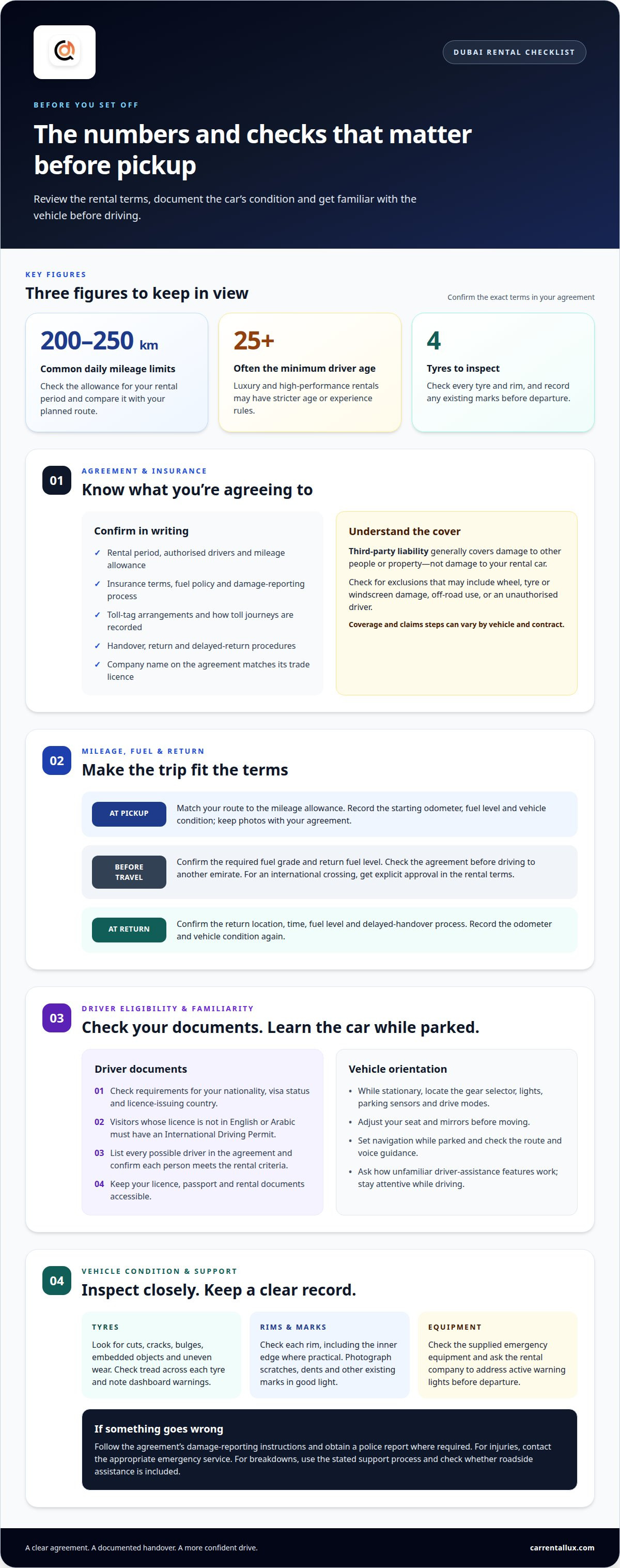
Compare luxury car rental offers by their written terms, vehicle condition and service arrangements, not by model name alone. Check that the rental agreement states the rental period, authorised drivers, mileage allowance, insurance, fuel policy and procedures for reporting traffic fines or damage. Confirm whether an electronic toll tag is fitted and how toll journeys are recorded. Check that the company name on the agreement matches the company’s trade licence.
Read the insurance terms carefully. Third-party liability generally covers damage to other people or property, not damage to your rental car. Check the policy for exclusions, which may include wheel, tyre or windscreen damage, off-road use, or driving by an unauthorised person. Review the agreement and insurance terms to understand what the policy covers after damage or an accident. Coverage and the claims process can vary by vehicle and contract, so check these details before signing.
Before setting off, inspect the car in bright light and photograph or film scratches, dents, wheels and the interior. Make sure every existing mark is recorded in the agreement and keep a copy. Check the agreement for vehicle handover and return procedures, and keep any documents provided with your rental paperwork. This record can help you refer to the car’s condition throughout the rental.
If damage occurs, follow the agreement’s reporting instructions and obtain a police report where required. For an emergency involving injuries, contact the appropriate emergency service. For other incidents, follow local police reporting procedures. If the car breaks down, use the support instructions in your rental agreement and check whether roadside assistance is included. Keep the agreement, insurance documents and incident records together throughout the rental.
Third-party liability generally covers damage to other people or property, but not damage to the rental car. Check the policy for exclusions, including wheel, tyre or windscreen damage, off-road use and unauthorised drivers. Review the rental agreement and insurance terms to understand the coverage and reporting process after damage or an accident, as these can vary by vehicle and contract.
Mileage Limits, Fuel Policy and Return Terms
Before collecting a rental car, match your planned route with the mileage allowance in the agreement. Daily limits commonly fall between 200 and 250 km, so a long inter-emirate journey could use a substantial share. Confirm the allowance for your rental period. Note the starting odometer reading and compare it with the return reading. A clear record helps explain any mileage calculation.
Fuel rules matter, particularly for luxury cars with high-performance engines. Confirm the required fuel grade and the return fuel level. Photograph the fuel gauge and odometer at pickup, and keep the images with your agreement. If your plans include extended parking or several stops, leave time to refuel before the agreed return time.
Before driving to another emirate, check the agreement for permission and any conditions specific to the vehicle. For an international border crossing, don’t assume the car may leave the country. Review the rental terms for explicit approval and any related requirements before planning the journey.
Read the cancellation terms alongside the pickup and return details. Confirm the return location, time, fuel level and procedure for a delayed handover. If your schedule changes, follow the agreement’s cancellation or amendment process rather than simply missing pickup.
Understand the breakdown support arrangements before setting off. Check the agreement for roadside assistance coverage and how to report a fault. If the car develops a problem, stop somewhere safe and follow the stated support process. Keep your rental documents accessible, and record the odometer and vehicle condition when the car is returned.
Driver Eligibility and Vehicle Familiarity
Check driver eligibility before booking, because Dubai requirements can depend on nationality, visa status, licence-issuing country and rental terms. Luxury and high-performance rentals often require drivers to be at least 25 years old, with stricter age or experience rules for some vehicles. Visitors whose driving licence isn’t in English or Arabic must have an International Driving Permit. Residents and eligible short-term visitors can face different licence requirements.
At booking, compare the lead driver’s documents with the names listed in the agreement. Add everyone who may drive, as unauthorised drivers can affect insurance coverage. Confirm that each driver meets the rental company’s age and driving experience criteria before pickup. Keep the licence, passport and rental documents accessible during your trip.
Give yourself time at pickup to learn the vehicle before entering busy Dubai traffic. A premium sports car can respond differently from the car you normally drive. Locate the gear selector, lights, parking sensors and drive-mode controls while stationary. If the car has a Porsche-style low seating position or unfamiliar steering response, adjust your seat and mirrors before moving.
Set your navigation while parked, then check that the route and voice guidance are clear. If fitted, ask how unfamiliar driver-assistance features, such as cruise control or lane alerts, work. Learn how to adjust or switch off each system using the vehicle’s controls. Treat assistance as support, not a substitute for attentive driving. A calm orientation helps you manage acceleration, braking and tight parking more precisely.
Tires, Rims and Emergency Equipment
Before accepting a luxury car, inspect each tyre for cuts, cracks, bulges, embedded objects and uneven wear. Look at the tread across the tyre, not just at the outer edge. Compare all four tyres for obvious differences and check for dashboard warnings. If a warning light is active, don’t rely on appearance alone. Ask the rental company to address it before departure. A thorough inspection protects the vehicle condition record and gives you greater confidence on the road.
Examine every rim for fresh scratches, dents or visible damage, including the inner edge where practical. Photograph marks beside the affected wheel and make sure existing damage is documented before you leave. Low-profile tyres and prominent rims on a sports car can be more exposed to curb contact, so take care around tight parking spaces. A Lamborghini’s dramatic stance may turn heads, but comfort and control depend on sound tyres and wheels.
Ask what emergency equipment comes with the rental, then locate it before setting off. Check the condition of any supplied warning triangle, inflator, repair kit or spare, and learn how to use it according to the vehicle’s instructions. Equipment varies by car, so don’t assume every model carries the same items. If a warning appears during your rental, stop somewhere safe and follow the agreement’s breakdown instructions.
For a convertible, check that the roof operates correctly while the car is stationary, then confirm how to secure it before driving. At pickup, record the odometer and confirm the mileage limit alongside any tyre or rim concerns. Clear photos, written condition notes and a quick equipment walkthrough give you a precise handover record. Expect this focused check to take only a few minutes, and complete it before accepting the keys.
Choosing Quick Luxe Car Rentals for Your Dubai Trip
Quick Luxe Car Rentals gives travelers in the UAE a premium-car rental option for journeys where comfort, presence or performance matters. Choose a model around your plans, passengers, luggage and driving preferences, not appearance alone. Options include the Range Rover Vogue 2025, Mercedes G63 Black 2024, Rolls Royce Ghost Blue and McLaren Artura Spyder Orange 2025. Each offers a distinct style for a business visit, leisure drive or family itinerary.
Start by considering what suits your trip. An SUV may work better for your group and luggage, while a convertible or sports car may better match your plans. Review the rental terms for your chosen model, including authorised drivers, insurance, mileage, fuel and return arrangements. This connects your vehicle choice with the details that shape the trip, so you can make a considered booking rather than choosing on prestige alone.
Quick Luxe Car Rentals also provides pick-up, delivery and collection, useful when coordinating an arrival or departure. Its Barsha hub is open Monday to Saturday from 8:30 am to 8:30 pm, and the business says its customer service team is available 24/7. Plan your handover around your schedule and keep the agreement accessible throughout the rental.
The rental team can help you consider vehicle options and booking details for your trip. Before setting off, review the agreement, document the car’s condition and familiarise yourself with its controls. A smooth rental experience starts with a suitable model and clear terms, followed by a careful handover and preparation.
For your trip, contact Quick Luxe Car Rentals to discuss your rental.
Frequently Asked Questions
What should I check before renting a luxury model in Dubai?
Before booking, review the agreement’s authorised-driver, mileage and return terms, then inspect the specific car. For a convertible, check that the roof works; for an SUV, consider passenger and luggage space. Record the odometer and any visible marks at handover. Knowing what to check before renting a luxury car also means understanding its controls before driving in unfamiliar traffic.
Can I choose which model I will get?
Quick Luxe Car Rentals lists individual models, including the Range Rover Vogue 2025, Mercedes G63 Black 2024 and Ferrari 296 GTB Red 2023. Select the model shown in your booking details and keep that record with your rental documents. A named model helps distinguish your chosen vehicle from a general category such as an SUV or sports car.
What should I know about insurance for a rental car?
Don’t drive a rental car until its insurance arrangements are clear in the rental documents. The paperwork should identify the applicable coverage and exclusions. If a booking document does not clearly define coverage, resolve that before accepting the keys. Third-party liability is not the same as cover for damage to the rental car.
Can You Rely on Credit Card Rental Insurance?
Don’t assume a credit card benefit covers every luxury rental or type of damage. Card policies have their own eligibility rules, vehicle exclusions, geographic limits and claim procedures. A benefit may cover some rental damage while excluding a high-performance model or certain incidents. Read the benefit terms alongside the rental agreement, especially its damage exclusions.
Does Your Personal Auto Insurance Cover a Luxury Rental?
Your personal auto policy does not automatically provide insurance for a rental car. Policy terms define which vehicles, drivers, locations and uses are covered, and luxury or high-performance models may be treated differently. Review the wording for rental-car coverage and exclusions. Keep it separate from the rental agreement, which sets your responsibilities for the specific vehicle and booking.